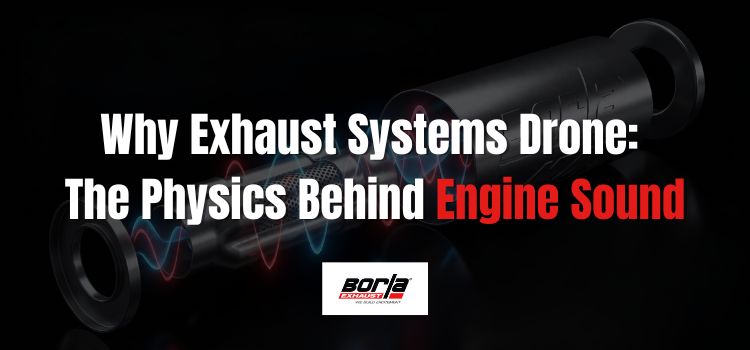
Why Exhaust Systems Drone: The Physics Behind Engine Sound
An engine's signature sound is rooted in frequency and physics, not opinion. Before tone or volume, there is firing frequency. That baseline rhythm is the audible result of pressure pulses leaving the cylinders and interacting with both the exhaust system and the vehicle's cabin.
If you're trying to engineer or choose an exhaust that sounds good without the monotonous low-frequency "drone" on the highway, you start with this fundamental exhaust pulse frequency.
Understanding Drone
Before diving into the math, it is important to define the phenomenon every enthusiast wants to avoid: drone.
Drone is often confused with volume, but it isn't just about an exhaust being 'too loud.' Instead, it is a specific, monotonous low-frequency vibration. To understand how drone occurs, it is necessary to separate three distinct physical phenomena involved in vehicle acoustics:
- Engine Firing Frequency: This is the source, defined strictly by engine RPM and cylinder count.
- Exhaust System Resonance: The exhaust system, including pipes, chambers, and the tailpipe outlet, has its own natural acoustic modes based on geometry and construction. Certain frequencies can be reinforced or reduced within the exhaust before sound ever reaches the tailpipe.
- Cabin Resonance: The vehicle interior acts as an enclosed acoustic cavity with its own acoustic modes based on interior volume and structure.
In practice, drone does not require perfect alignment across all these domains. Instead, drone is most noticeable when the engine's firing frequency or one of its harmonics produces strong low-frequency energy that is not sufficiently attenuated within the exhaust system and falls within a frequency range the cabin naturally amplifies. When engine energy excites these acoustic modes, low-frequency reinforcement occurs, creating a persistent 'hum' or physical pressure that can make highway cruising exhausting.
The Calculation: The Heartbeat of Your Engine
To pinpoint the exact frequency of an engine's exhaust pulses, we look at the physics of the combustion cycle. Because this frequency dictates the acoustic baseline, it can be calculated in three logical steps.
Step One: Convert Engine Speed
Engine speed is measured in revolutions per minute, or RPM. To work with sound frequency (which is measured in hertz, or cycles per second), RPM must be converted into revolutions per second.
Revolutions per second = RPM ÷ 60
Step Two: Determine Firing Events
In a four-stroke engine, each cylinder fires once every two full crankshaft revolutions. Because of this, the number of firing events per crankshaft revolution equals the number of cylinders divided by two.
Firing events per revolution = Cylinders ÷ 2
Step Three: Calculate the Frequency
To find the firing frequency, multiply the revolutions per second by the firing events per revolution. Written out plainly:
Firing Frequency (Hz) = (RPM ÷ 60) × (Cylinders ÷ 2)
That same relationship can then be simplified into a single, clean expression:
Firing Frequency (Hz) = (RPM × Number of Cylinders) / 120
This number represents the fundamental exhaust pulse frequency. It is the starting point of engine sound, not the entire sound profile. In addition to the fundamental frequency, engines also generate harmonics, which are higher frequency multiples of the base firing frequency that combine with the fundamental tone to shape the overall sound character. Furthermore, firing frequency always changes with RPM; a specific value only applies at a specific engine speed.
Firing Frequency in Action
While the math provides the blueprint, firing frequency is a dynamic force. To see how these theoretical numbers translate to the road, let's look at two examples.
Example 1: The V8 at Cruise (2000 RPM)
When driving a V8 engine at a typical highway cruise of 2,000 RPM, the math behind the exhaust note looks like this:
2000 RPM ÷ 60 = ~33.3 revolutions per second

8 cylinders ÷ 2 = 4 firing events per revolution

33.3 × 4 = ~133 Hertz (Hz)
Operating at 2,000 RPM yields a fundamental frequency near 133 Hz. This is why a V8 at cruise is often associated with this specific frequency. If the exhaust system does not sufficiently attenuate energy in this frequency range and the cabin naturally amplifies it, the result can be the low-frequency pressure commonly perceived as drone.
Example 2: The Inline-Four at Idle/Low Speed (1500 RPM)
1500 RPM ÷ 60 = 25 revolutions per second

4 cylinders ÷ 2 = 2 firing events per revolution

25 × 2 = 50 Hertz (Hz)
This significantly lower fundamental frequency helps explain why four-cylinder engines have a completely different tonal character and resonance behavior compared to a V8.
Managing the Interaction
Drone is not about loudness; it is about frequency alignment. Poorly engineered systems unintentionally reinforce frequencies where exhaust system resonance and cabin resonance overlap. Well-engineered systems manage these interactions deliberately through geometry, volume tuning, and frequency-targeted attenuation within the exhaust structure.
Effective exhaust engineering requires understanding and managing how firing frequencies and harmonics interact with both exhaust resonance and cabin resonance across the entire RPM range. The emphasis must be on frequency control rather than just volume, managing harmonics rather than chasing decibels, and tuning systems differently for cruise versus acceleration.
This explains why two engines with the same cylinder count can sound very different depending on how the exhaust system is engineered. Because firing frequency and resonance behavior are measurable and predictable, they can be engineered deliberately. Effective exhaust design intentionally shapes, attenuates, and redistributes frequency energy so objectionable low-frequency alignment is minimized while performance character is preserved.
Great exhaust sound is not an accident. It is engineered.